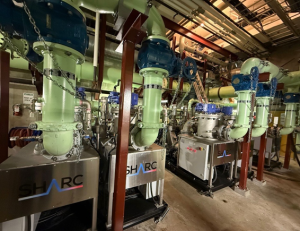
Vancouver – (October 23, 2025) – SHARC International Systems Inc. (CSE: SHRC) (FSE: IWIA) (OTCQB: INTWF) (“SHARC Energy” or the “Company”), a world leader in Wastewater Energy Transfer (“WET”), is proud to announce that SHARC Energy has completed the supply and commissioning of five of its patented, best-in-class SHARC 880 systems at the False Creek Neighbourhood Energy Utility (“False Creek NEU”) Expansion.
The expansion has tripled the capacity of the False Creek NEU from 3.2 megawatts (“MW”) to 9.8MW making it the largest operating WET project in North America. Additionally, the expansion has significantly reduced the city’s reliance on the BC Hydro power grid due to the annual average Coefficient of Performance (“COP”) for generating heat at False Creek NEU of over 300%.
The False Creek NEU, which is considered a District Energy System (“DES”) or Thermal Energy Network (“TEN”), serves over 1,900,000 square metres of new development in Southeast False Creek, Mount Pleasant, the False Creek Flats and Northeast False Creek.
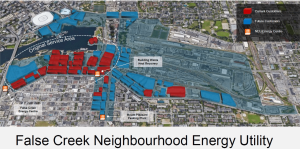
“The False Creek Neighbourhood Energy Utility is a great example of Vancouver’s ingenuity – we’ve literally turned raw sewage into an energy resource for the community,” said City of Vancouver Mayor Ken Sim. “Energy that would have been wasted down the drain is now heating commercial and residential spaces in parts of our most densely populated neighbourhoods.”
It should be noted that the False Creek NEU is self-funded, simultaneously providing affordable rates to customers and a return on investment to City taxpayers. Furthermore, it is estimated that this completed expansion will result in an estimated carbon emission reduction of 4,400 tonnes a year.
The Company will service and maintain these systems for five years with a City of Vancouver option for an additional five years.
DES/TENs are an underground infrastructure asset where thermal energy is provided to multiple buildings from a central energy plant or plants. Steam or hot water produced at the plant is transmitted 24/7 through highly insulated underground thermal piping networks. The thermal energy is transferred into and from each building’s energy transfer stations, reducing mechanical room space required for housing equipment and simplifying heating and cooling systems. SHARC Energy’s equipment enables DES or TENs to leverage wastewater and other hydronic sources as a reservoir of thermal energy making it a key enabler of electrified, low-carbon urban infrastructure particularly within dense city cores where wastewater flows are constant and predictable.
“The False Creek NEU sets the example for WET supported district energy systems and serves to educate and grow awareness about the renewable thermal energy opportunities contained within a forgotten resource—Wastewater,” says Michael Albertson, President, CEO and Director of SHARC Energy. “SHARC Energy’s continued growth is fortified as developers are requesting their architects and engineers to specify SHARC technology as the basis of design across North America and globally. We are very excited for the future of WET.”
The Company’s patented SHARC Series WET technology has become the foundation of modern district energy system planning across North America and globally. Recognized by architects, engineers, utilities, and sustainability leaders as the best-in-class WET solution, SHARC systems are being specified as the basis of design for an exponentially growing number of district and thermal energy network projects. Many of these projects in design are larger and exceed the capacity of the False Creek NEU.
The SHARC Series ability to capture and reuse thermal energy from wastewater and other hydronic sources, providing continuous, bidirectional energy for heating, cooling and potable hot water generation is unmatched in the marketplace and WET is a key enabler of electrified, low-carbon urban infrastructure, particularly within dense city cores where wastewater flows are constant and predictable.
Currently, there are several WET district energy projects in development in various stages across the lower mainland of British Columbia. Quietly, the Metro Vancouver region is becoming the Wastewater Energy Transfer capital of the world showcasing energy and climate leadership in how other regions globally can leverage a forgotten resource like wastewater to heat, cool and water heat while reducing or eliminating natural resource depletion such as fresh water used in cooling towers or burning of fossil fuels for heating.
In North America, recent years have shown the proliferation of legislation supporting DES or TEN systems and growing. Currently, eleven states, up from eight in May 2025, including Massachusetts, Minnesota, New York, Colorado, Washington, Maryland, Vermont, California, Texas, Maine and Connecticut have legislation that either allows or mandates utilities to develop thermal energy network demonstration projects or pilots.